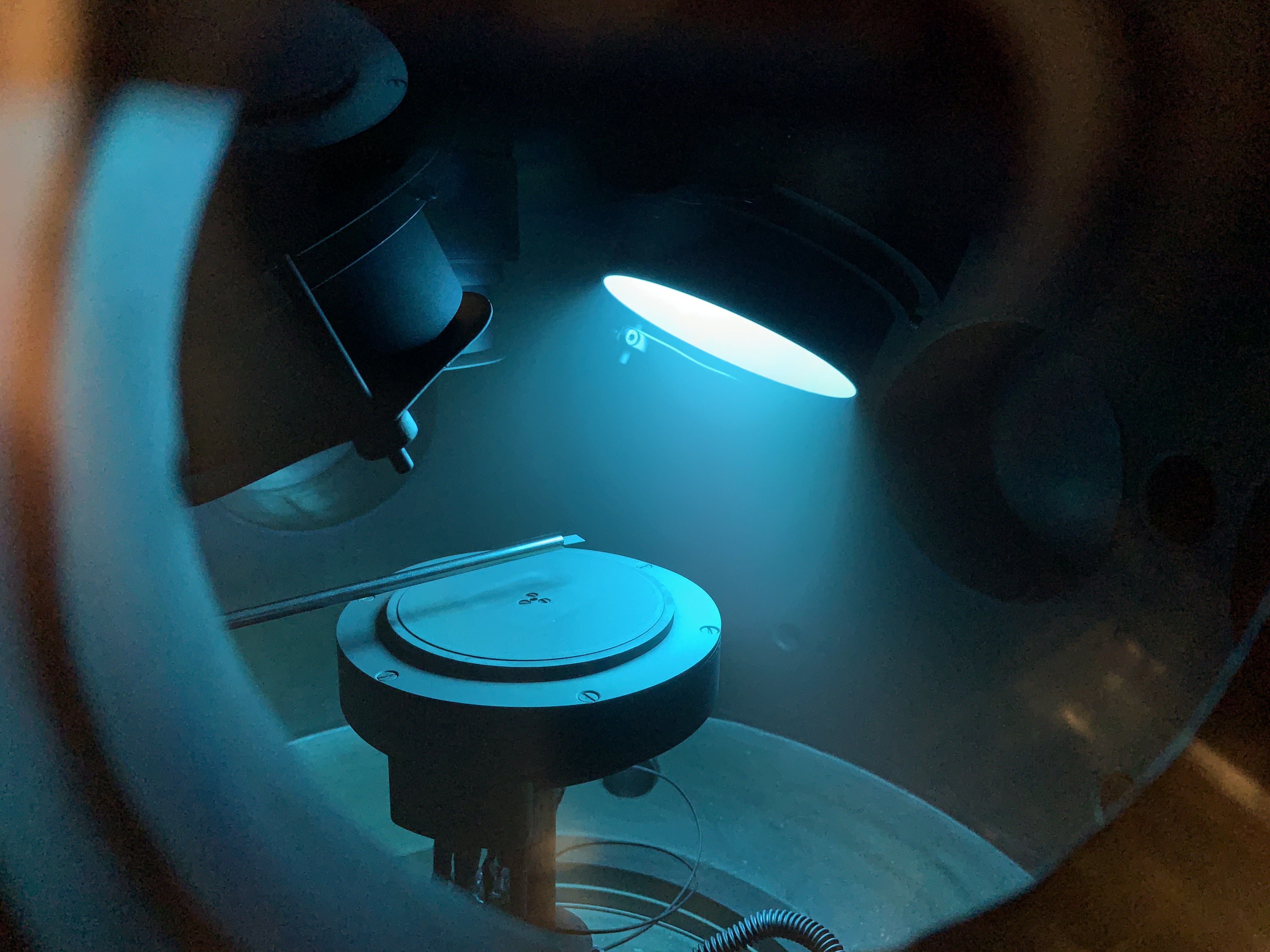
Combinatorial thin-film synthesis and automated property characterization across hundreds of compositions in a single campaign.
Replacing sequential material evaluation with complete composition-property map. A first campaign can serve as a standalone initial study. Multi-round programs use earlier results to direct subsequent runs toward the most informative composition regions.
Identify elements and composition ranges. Together we decide on characterization targets.
Up to 7 elements co-sputtered onto a 100 mm wafer in one run. Creating 342 unique physical thin-film compositions.
Every composition is measured for the relevant properties e.g. phase, electrical, optical, or magnetic.
Receiving a full dataset showing where the properties you need exist across the scanned composition space.
Bayesian optimization uses results to direct the next campaign toward the most informative composition sub-spaces.
Target compositions are produced as controlled uniform depositions for downstream validation, prototyping, and scale-up.
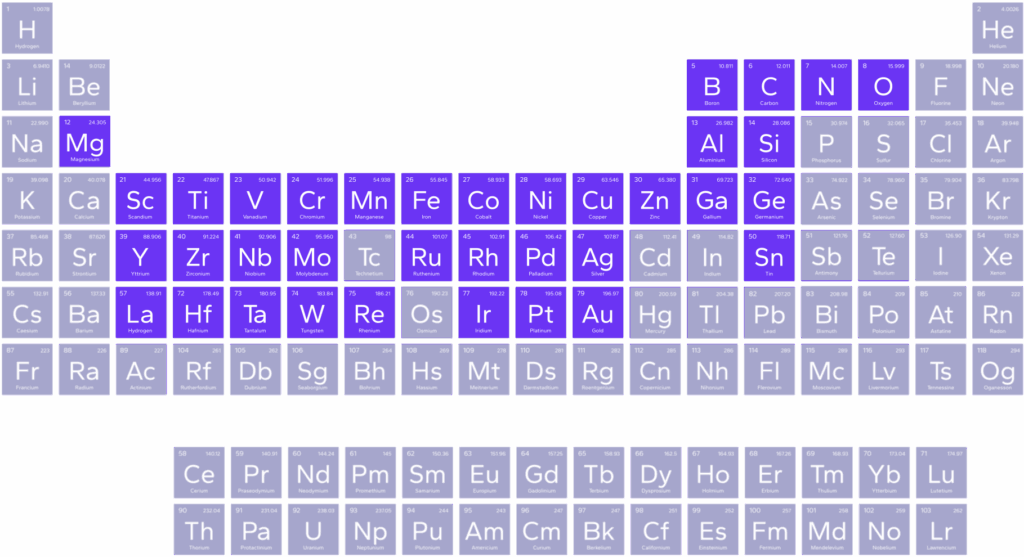
Our technology is suited to any material challenge where composition determines functionality and the relevant space is too large to navigate one material at a time. The following domains represent active and completed campaigns:
Activity-stability tradeoffs mapped across HEA composition space using the Scanning Droplet Cell. Published results across the Ni-Pd-Pt-Ru and Co-Fe-Ni systems.
Multi-element composition screening for CO2 reduction electrocatalysts. Completed campaigns with industrial customers in energy and specialty chemicals.
Reactive co-sputtering of multi-element nitride systems. CrAlN and related transition metal nitride systems mapped by XRD phase analysis, plasma diagnostics, and nanoindentation.
Optical property mapping across multi-element composition gradients using UV-VIS reflectance spectroscopy combined with 4-point probe electrical characterization.
Systematic screening of multi-element alloy composition spaces with integrated structural and mechanical characterization.
Ternary and quaternary composition screening beyond binary TaN. 4-point probe resistivity and XRD phase mapping across the full composition gradient.
MOKE maps magnetic properties across all 342 composition points simultaneously, combined with XRD phase identification.
Corrosion potential mapping via SDC and contact-resistance mapping via 4-point probe across multi-element composition gradients.
Integrating combinatorial PVD deposition system with automated characterization instruments. Every composition point in a campaign is measured directly.
On the composition library: The 342 composition points per campaign result from a continuous lateral composition gradient inherent to the co-sputtering geometry, not separately controlled discrete depositions. For production of a single target composition, controlled uniform depositions are available following campaign-based identification.
You choose the elements; we create the physical material solution tailored to your specifications.
Material Screening | Accelerated Material Prototyping | Coating Solutions
We create alloys and thin-film materials. Depositing real, physical thin-film samples across a continuous composition gradient on a single 100 mm wafer. One campaign produces 342 distinct compositions. Every point is characterized directly. The result is a complete composition-property map, not a model or calculation. Rather than evaluating one material at a time, your team can screen hundreds in a single run and focus on the candidates that matter.
1. Material Screening: Finding optimum materials.
Our customers receive curated results from our data-driven screening that integrates experimental design, sample preparation and characterization in a streamlined workflow.
2. Accelerated Material Prototyping: Providing prototype samples.
Data generated under laboratory conditions is an ideal starting point for optimization, but the validation must take place under application conditions. We create coatings of almost any possible alloy both on flat and structured substrates.
3. Coating Solutions: Production scaled to your demand.
Once a material solution has been validated, the next step is the production at the scale your application requires. We collaborate with trusted manufacturing partners to deliver custom-coated materials for pilot-scale testing or industrial implementation.
Combinatorial co-sputtering: Up to 7 elements are deposited simultaneously via magnetron sputtering in a single run. DC, RF, pulsed DC, HiPIMS, and reactive sputtering (N2, O2) are all available, covering metals, alloys, nitrides, and oxides. The composition varies continuously across the wafer, producing a laterally resolved library of 342 unique thin-film compositions.
Multi-element and high-entropy systems: The platform was built for composition spaces too large to navigate sequentially. Core operating domains include transition metal nitrides, high-entropy alloys, and multi-component oxides. Transition metals and their combinations form the primary operational range of the system.
Initial study or multi-round campaign: A campaign can be a single exploratory study or a multi-round program. The first run maps a slice of the composition space. Subsequent campaigns use property data from earlier runs to direct focus toward the most informative regions.
From composition map to prototype: Once a campaign identifies target compositions, controlled uniform depositions on flat or structured substrates are available for downstream validation and prototyping. Scale-up to production is handled via established manufacturing partners.