Accelerating Materials Characterization by Merging Simulation and Experiment
Authors: Markus Stricker, Lars Banko, Nik Sarazin, Niklas Siemer, Jörg Neugebauer, Alfred Ludwig
Published by: Ruhr University Bochum & Max Planck Institute for Iron Research
Keywords: active learning, pyiron, high-throughput, Gaussian process regression, automation, materials discovery
A New Paradigm in Materials Research
In the rapidly evolving world of materials science, the integration of simulation and experiment is no longer a distant goal—it’s becoming a practical reality. This study introduces a groundbreaking approach to experimental materials characterization that leverages concepts from high-throughput computational workflows, using a unified development environment called pyiron.
Bridging Simulations and Experiments
Traditionally, simulation and experimental workflows have operated in silos. But by embedding experimental routines directly within a simulation-oriented framework, researchers have demonstrated a system where experimental jobs can be controlled, optimized, and analyzed in the same way as simulations.
This approach enables data-driven decision-making using Gaussian Process Regression (GPR) to guide experimental measurements—greatly reducing the number of necessary measurements while preserving data quality.
Case Study: Resistance Mapping of Metal Alloys
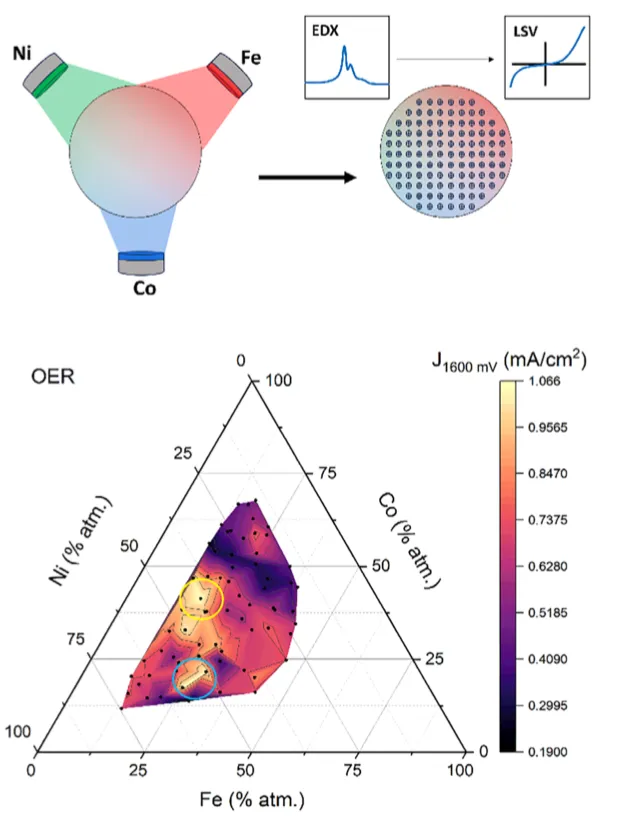
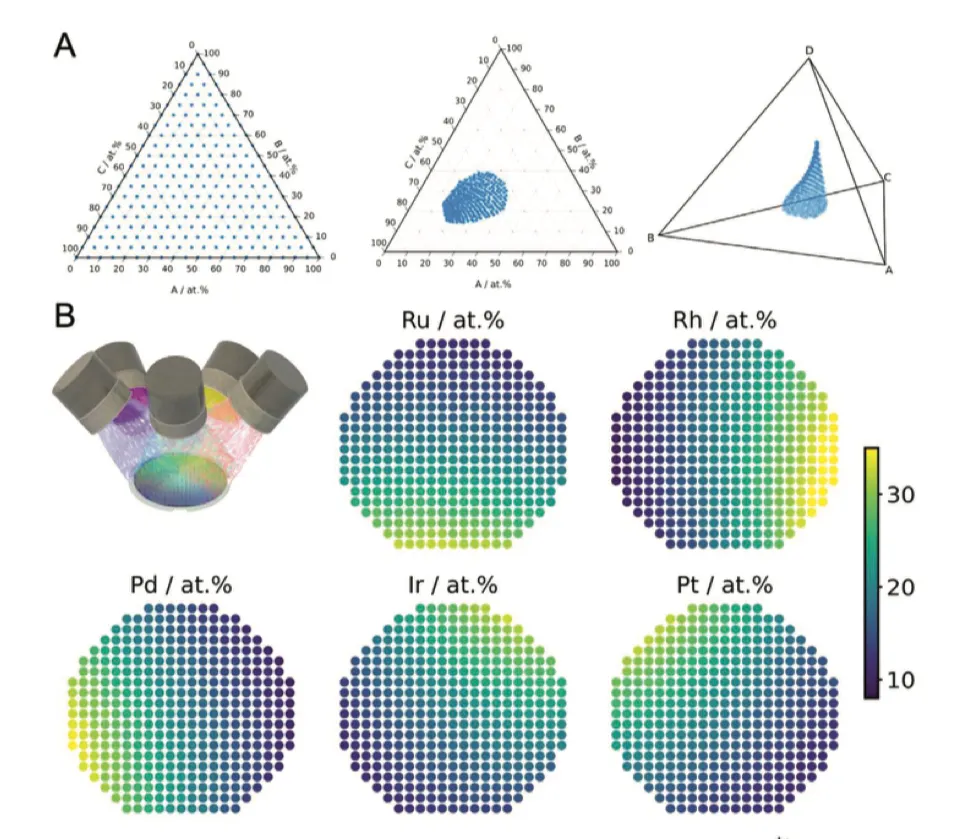
Using a thin-film material library of Ir–Pd–Pt–Rh–Ru alloys, the team showed that by measuring only ~12% of the total samples and predicting the rest with GPR, the process could be accelerated by a factor of 10. The approach preserved accuracy while minimizing time and effort.
Key Innovations
-
Unified data framework: Simulations and experiments share a common platform for data management and orchestration.
-
Adaptive sampling: Instead of brute-force scanning, the system targets high-uncertainty regions for measurement, improving efficiency.
-
Scalability: The approach is designed to be extendable to real-world experimental hardware and robotic labs.
Looking Ahead
This study marks an essential first step toward autonomous materials discovery, where computational models, robotic labs, and active learning algorithms collaborate in a closed-loop system. While full automation may still face technical barriers—like proprietary lab software—the conceptual and technological groundwork has now been laid.