Authors: Rajini P. Antony, Ridha Zerdoumi, Sascha Saddeler, Olga A. Krysiak, Lars Banko, Alfred Ludwig, Wolfgang Schuhmann
Efficient Water Electrolysis Begins with Smarter Catalysts
Electrochemical water splitting offers a clean and scalable method for hydrogen production, but the oxygen evolution reaction (OER) remains a major bottleneck. In this study, researchers introduce a high-throughput screening strategy to identify high-performance Co–Fe–Ni alloy electrocatalysts for water electrolysis at industrial-level current densities.
High-Throughput Discovery
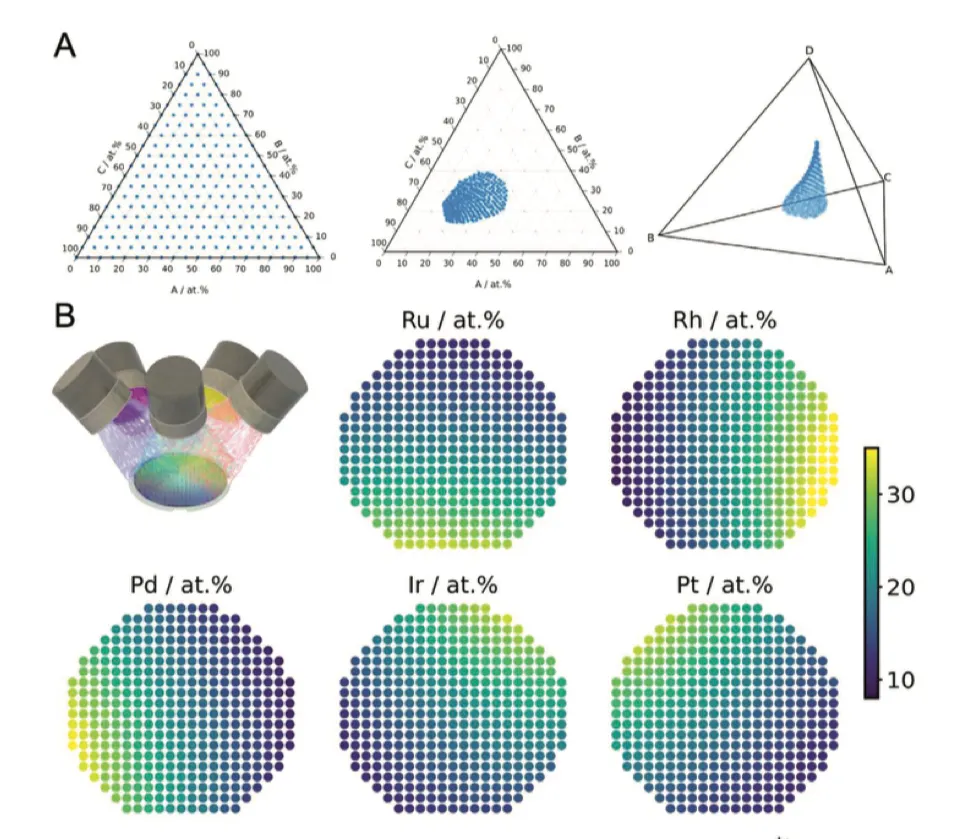
Using a scanning droplet cell and thin-film materials libraries, over 400 compositions within the Co–Fe–Ni system were rapidly screened. The study identified two regions of high catalytic activity, with the best-performing composition being Co₁₇Fe₂₅Ni₅₈, which demonstrated superior OER activity and long-term stability.
Scalable Electrode Fabrication
Top-performing compositions were synthesized via electrodeposition onto nickel foam. This method is not only cost-effective and scalable but also reproducible, making it ideal for industrial applications. Surface and electrochemical characterizations confirmed the formation of uniform, active catalyst layers.
Record Performance Under Harsh Conditions
Co₁₇Fe₂₅Ni₅₈ achieved a stable current density of 1 A cm⁻² at ~1.9 V, and up to 2.5 A cm⁻² at 1.55 V vs RHE.
The catalyst showed minimal degradation even after 30 hours of continuous operation with shutdown-restart cycling.
Raman spectroscopy revealed the formation of the highly active γ-NiOOH phase at higher potentials, which plays a key role in OER activity.
Why It Matters
This work provides a complete, scalable approach — from composition screening to MEA-based flow cell testing — for developing robust electrocatalysts. The findings bridge the gap between lab-scale research and practical implementation in green hydrogen production systems.
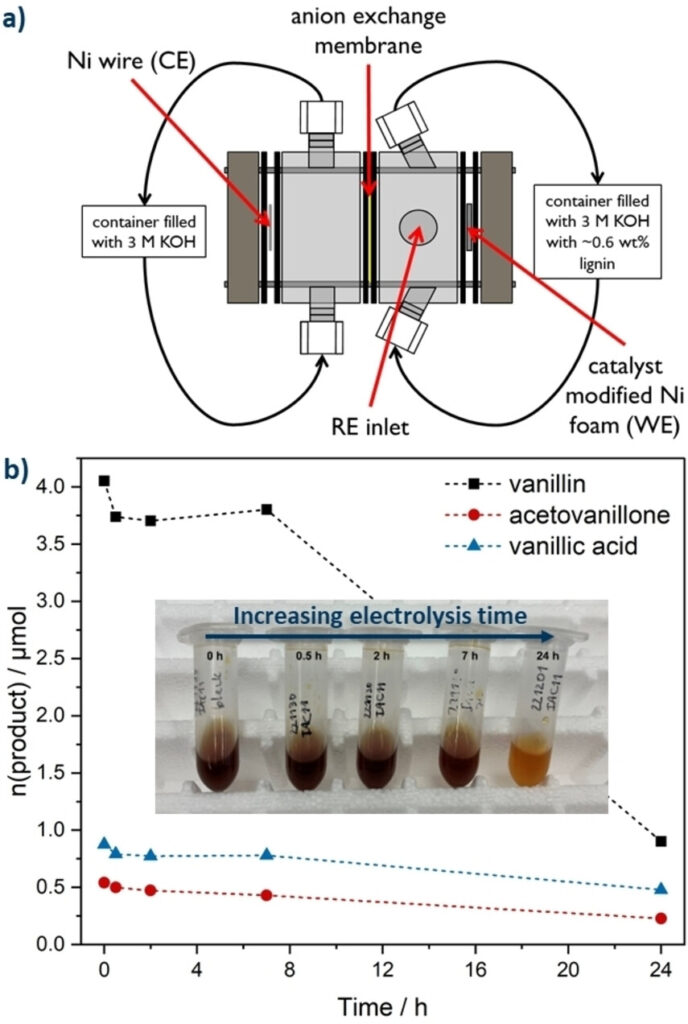
Oxidative Depolymerisation of Kraft Lignin: From Fabrication of Multi-Metal-Modified Electrodes For Vanillin Electrogeneration via Pulse Electrolysis To High-Throughput Screening of Multi-Metal Composites
Topics: lignin electrooxidation,pulse electrolysis,vanillin production
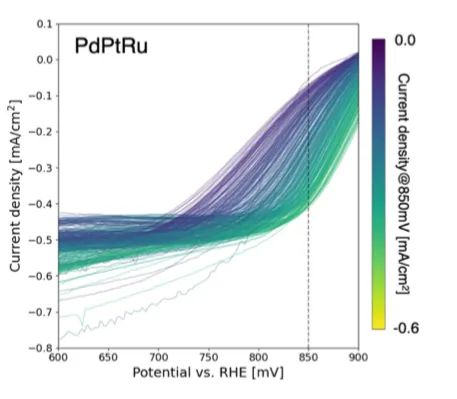
Unravelling Composition–Activity–Stability Trends in High Entropy Alloy Electrocatalysts by Using a Data-Guided Combinatorial Synthesis Strategy and Computational Modeling